Thursday, April 05, 2007

Just try it.


Try googling "masamune effect". It has to be in quotes for this to work. I was looking for a specific reference and was too lazy to go to Web of Science right away. I got a good chuckle for my efforts, but little else.
Sorry I haven't blogged in a bit. I'm recovering from an unfortunate turn of events that I'd prefer not to post about, and my computer time's being eaten up by other things these days.

..when you're done with that, read the real references, if you're so inclined. (I did have to go outside of Google to find them, since this work is mentioned offhand in many more recent papers.)
(a)W. Choy, L. A. Redd III., S. Masamune, J. Org. Chem. 1983, 48, 1137-1139;
(b) S. Masamune, L. A. Reed III., J. T. Davis, W. Choy, J. Org. Chem. 1983, 48, 4441-4444.

Satoru Masamune, while a professor of chemistry at MIT, made many contributions to the field of chemical synthesis. These two papers describe some of his contributions to the Diels-Alder reaction, one of my adviser's favorites.
The Diels-Alder reaction is artistic (it can let us sculpt 3D molecules out of flat precursors), it's green (no waste atoms lying around after the reaction, with just a few exceptions), and chemists have gotten pretty good at controlling and predicting its power.

Back to Masamune's papers. This work describes a small reactant with a defined 3D structure, which reacts very well at low temperatures, catalyst-free (green again, low energy requirement) with a variety of partners. The best part about this reactant was that one could predict the 3D structure of the products for the reaction. Masamune surmised that this was made possible by hydrogen bonding interactions occurring over the course of the reaction. That's a strategy taken straight out of the enzyme's playbook.

I picked the picture because I've always been fascinated by those desk toys. If you could turn the magnet on and off at will, I think it's a pretty decent basic illustration of the concept of building 3D things from flat things.

*UPDATE 4/28/07. Apparently, "She Blinded Me with Science" is now the top hit when you try googling "masamune effect". Neat.

Labels:

Wednesday, March 21, 2007

Whither the protecting group?


Kudos to Phil Baran's group, who have just published in the journal Nature describing protecting-group (PG) free syntheses of members of the hapalindole, fischerindole, welwitindolinone and ambiguine families.
the ref: Nature 2007, 446, 404-408.
His group has published the enantioselective total synthesis of some of these compounds before (see, for instance, JACS 2005, 127, 15394-96.) but I'm guessing Nature deemed this worthy because of its unified application of a few big philosophies of organic synthesis (ie, atom economy and convergency) while trying to evaluate the pros and cons of going PG-free, as well as its overarching call for hearkening back to the early days, when men were men and syntheses were PG-free. That, and they optimized the routes to welwitindolinone and fischerindole to get higher yields.
So what is a protecting group? For organic chemists, they are a way of reining in the more unruly sections of the molecule you happen to be making. To be more specific, it's necessary to mask parts of the molecule that are likely to behave in some way other than what you'd like, or that refuse to "go along quietly" when some other part of your molecule needs attention.
For a great description, take a look here for Dylan Stiles' (aka Tenderbutton's) rather prescient article about the protecting group and some classic examples thereof.
Is the "PG-free way" really Mother Nature's way? If not, is her favorite protecting group the MOM group?
I think that some masked chemical reactivity exists in the biological world. I hope that my more scientifically inclined readers won't take offense at my stretching an analogy just a bit for the sake of a blog entry.
Take enzymes like proteases. Proteases break the bonds that link up the fundamental building blocks in proteins, and they're involved in many important roles in the body, from blood clotting to cell death. It's extremely important that proteases be exquisitely regulated, so that they don't start chopping up proteins willy-nilly. The "protecting groups" for proteases are in place at the beginning, during their production. Proteases are built as inactive forms known as zymogens, and in order to reveal the active protease, there's a little sliver of protein (called a peptide) that's got to get lopped off.
the ref: Nature 1999, 402, 373-376.
That isn't the only mechanism for regulating proteolysis. You can imagine that if a protease somehow gets activated at the wrong time, or in an out-of-control way, there would be dire consequences (ie, too much protease activity could contribute to stroke or alzheimer's).
When that happens, one natural defense mechanism is the serpin class of proteins. Serpins permanantly (covalently) inhibit proteases, mostly the serine type.

Incidentally, this is the most chemistry I've ever seen in an issue of Nature. Besides the Baran paper and the intro to it by Porco, there's a great piece by Bergman on C-H activation and a review by Toste. Plus, there's an article about chemistry in the NatureJobs section.
UPDATE 3/24: I should've realized Nature did that to coincide with the ACS national meeting.

Labels:

Tuesday, March 20, 2007

Will DOI cure what ails me?

As I mentioned on my last post, I've been busy reformatting tons of references, adapting something I've written before to satisfy a slightly different format.
Non-scientists, non-scholarly types: It's like writing that 8th grade term paper all over again, times 100. You know, the one where each of your sources for your bibliography had to be on a separate index card, and you had to get your mom to drive you to the Hackettstown Library to search (are you ready now?) the Readers' Guide to Periodical Literature for information on The Manhattan Project. I can't remember why I chose to write a term paper about the A-bomb at the tender age of 14, but a lot of what I read about for that paper still comes up.
But I digress.
The point is that reformatting references is unbelievably mundane work.
There is some computer software out there that's meant to take care of all that for you. The one I had started using is called EndNote. Endnote interfaces with Word, and it's smart enough to know that when you move text around, the numbers of your references will change if the order's been changed. It has templates for bibliographies in many different journals and can (supposedly) instantly reformat your references to a new journal.
Endnote didn't work well for me at all. I was working with a library of a couple hundred references for this review paper back in 2005. Unfortunately, I couldn't figure out a way to make the software format my references according to the specifications of the particular journal. So, once I was sure I was done shuffling text around, I switched my references to text-only and reformatted them manually, and now I'm reformatting once again.
Is there other, better software out there?
The biggest difference between now and when I was in eighth grade is the ease of access to the internet. One of the handiest technologies for keeping track of the scholarly literature is The Digital Object Identifier System, or DOI. DOI is like a homing device for a journal article, so that no matter where the content moves on the web, looking it up using a DOI locates it and retrieves it.
Recently, some Elsevier journals changed their web and old links no longer worked. If I'd set those links to the DOI of the journal article, they'd still be intact. That reminds me; I need to change my research group's "Publications" page so that everything is indexed by DOI.
What I'm wondering is whether there will come a point where DOI will become the universal reference citation standard, including in print. If that happened, I'd never have to worry about whether I should be using bold or italic font, or whether the authors' surnames come first or last, ever again. Just a simple URL would be all I'd need. However, part of me thinks that if journals (or is it the ACS Style Guidepeople?) were ever going to adopt uniform, URL-based standards, they would have done it a few years ago, at the relative "dawn" of the internet age.
What are the barriers to this, if any? Is it a content searching issue?
If you were going to pick a universal reference style, what would it be and why?

Labels:

Monday, January 08, 2007

Triangle Club**


I wish I had the opportunity to learn more about concepts that are important to understand in developing a functioning drug. Derek's blog will have to suffice for now.
Today I'm posting about Naloxone and Naltrexone. They came up in a conversation about drug addiction (more on that later). These two molecules are opioid receptor antagonists that are strikingly similar in structure, but they're used in the clinic in different ways. An antagonist in the drug sense is something that binds to a receptor and stops the events/actions set in motion by another drug called an agonist. By itself, an antagonist doesn't do anything to the receptor.
(If you're lost and haven't read the links, suffice to say that the word "opioid" sounds like the word "opium" for a reason.)
See here for Molecule of the day's entry on Naloxone.
Naloxone clears your system more rapidly. It's given to patients who have overdosed on things like heroin or morphine. (I think the wikipedia entries I cited above may be confused here..) Naloxone essentially kicks the heroin/morphine off of the opioid receptor, and what you get is a rapid detox, complete with all the very painful symptoms of withdrawal. The detox process is almost instantaneous; the patient goes from completely passed out to completely awake in seconds. The process can also be done under anesthesia.
After detox, patients in rehab may take a once-daily pill of Naltrexone, which is much longer-acting. It'll keep any other opiates they may try to sneak from working.
The difference between the structures is actually really subtle. Note the cyclopropane Naltrexone substitutes for the Naloxone olefin. One extra carbon. Hmmm.
It's known in the literature that cyclopropanes can possess alkene-like reactivity.
What I'm not sure of (and don't have the time to look into in depth) are the differences in how they're metabolized. But here's something about metabolism of cyclopropanes that you can dig out of the literature pretty quickly:
The ref: Chem. Rev. 2003, 103, 1625-1647.

** and if you're into musical comedy and Ivy League tradition, see the Princeton Triangle Club's website.

Labels:

Friday, December 08, 2006

Trying not to use the obvious title joke here..

I think my favorite science to read about is the type where the central idea is so elegant, you wonder why no one had thought of it already. PCR is like that, and in my mind, so is this recent JACS ASAP.

The ref: JACS 2006, DOI: 10.1021/ja0657307 (subscriber link)

The background:
I was in a bioinorganic/ biophysical chemistry lab a few years back, and the topic of FRET came up a lot. If you're unfamiliar, FRET stands for Förster resonance energy transfer (you'll also see fluorescence resonance energy transfer), and it is a convenient visual tool for measuring distances. This comes in handy when you want to learn more about protein-protein interactions, receptor-ligand interactions, and conformational changes.

You need 2 fluorescent dyes for a FRET experiment. In a simple case, you attach one dye to protein A and the other one to molecule B, and watch for changes in how they interact. If you did everything right, you'll see a different-colored glow depending on whether A is close to B.
Of course, you conscientiously selected your dyes so that their energy profiles overlapped just right. If A and B are close together, when you shine a light that would otherwise make A glow, what you see instead is mostly B glowing. That's because instead of glowing, A is able to hand off its energy to B in a way. That phenomenon is what's called FRET. Read this if you're interested in more details. Also, Lakowicz's Principles of Fluorescence Spectroscopy is an excellent book that discusses the field.

The ACTUAL PAPER:
The authors wanted an easy way to visualize a working enzyme in a living cell in real time. In other words, no additional prep time to wash out excess dyes, or having to bust the cells open to "see" the results.
Rather than bringing in two dyes on two separate molecules, the research team made a probe with two carefully chosen dyes built in.
When the target enzyme is catalytically active, it cleaves a protective group from a phenol to yield a quinone methide. There's a leaving group involved in generating the quinone methide. In this paper, the leaving group was one of the dyes. After the labeling event, the dyes aren't close together anymore, so no more FRET. (I can't remember where the liberated acceptor dye ends up, or whether that was mentioned.) The quinone methide that's left behind is a highly reactive alkylating agent that's known to latch onto any nearby nucleophile in a protein. Bingo, protein labeling and color change in one shot.

Labels:

Monday, November 06, 2006

Belated Halloween Edition

Porphyrias are a family of relatively rare diseases that present symptoms reminiscent of the characters immortalized by Lon Chaney, Jr. and Bela Lugosi. There's ample discussion in the literature about whether these diseases spawned the myths we recognize today. Porphyria sufferers may have anemia, light sensitivity, and reddish colored urine, or excessive hair growth. The underlying problem has to do with how the body makes and utilizes porphyrin, part of an oxygen-carrying complex in our blood. The molecular underpinnings of the disease are largely unknown, but a recent Nature letter presents evidence that some porphyrias may be due to a defect in a specific protein.
the ref: Nature 2006, 443, 586-589.
This protein, called ABCB6, transports porphyrins to a place where they can bind to iron. This iron-porphyrin combo eventually ends up in hemoglobin. This work points out that it isn't necessarily just the production of porphyrins that's the problem, that getting porphyrins where they need to be so that they can do their job is equally important.
This idea reminds me a little of the distinction between Type I and Type II diabetes. The underlying theme that diseases with the same symptoms could come from "manufacturing" or "distribution" issues must be more common than I realize.
Type I diabetes: decreased or no insulin production
Type II diabetes: insulin's around, but the body isn't responding to it properly
There was supposed to be a chemistry grad student with porphyria beginning in my year, 2002. The department spent a sizable chunk of change renovating an entryway so that she could turn off all lights when she needed to, and they built her a private office and everything. (I think she would've been a computational chemist). She deferred enrollment for a year and then never arrived. Not sure where she is today.

Labels:

Monday, October 09, 2006

Knowing when to fold 'em

Science news reports that a team based at U.Penn. School of Medicine has found some common ground between Lou Gehrig's disease and a specific kind of dementia. Their results have pinpointed a known protein, TDP-43, as a culprit for the disease, and their work may instigate a reevaluation about how these diseases are studied, in addition to highlighting a potential drug target. TDP-43 is a major player in the signature "clumps" that develop in different locations of the brain during these neurodegenerative illnesses.
Background info: Clumps in brain tissue are generally not good. The place where clumps end up seems to determine which disease will affect a patient. Frontotemporal lobar degeneration is the #2 cause of dementia after Alzheimer's in people under 65. In that case, the clumps hang out in the part of the brain that controls good judgement and good behavior. With Lou Gehrig's disease (aka amyotrophic lateral sclerosis), the problem might be closer to the section controlling motions.
The ref:Science 2006, 314, 130-133.
I guess hindsight must be 20/20 for this research team, because in the past doctors have sometimes seen patients with Lou Gehrig's disease develop this type of dementia, and vice-versa.

Again: The important take-home message is that the final folded state of proteins in the brain is crucial. Proteins usually start out as a chain of amino acids and eventually fold up into an orderly structure. If a protein doesn't fold correctly, chances are it's not going to function correctly, either. This is a theme that happens over and over again, in Alzheimer's, mad cow disease, you name it. What comes to mind for me are all those origami fortune-tellers and paper footballs I folded as a kid. You needed to fold it just right to get a good game of cafeteria table football started. Scientists know very little about how to tell at-a-glance what a protein's folded-up shape will look like. That knowledge would be a major step forward in treating these diseases, and there are several different approaches out there researchers are taking to figure it out.
Off the top of my head:
-You've got the camp that designs proteins from scratch to study what specifically in the amino acid sequence calls out for a given folding pattern.
-You've also got the researchers using computers to attack the question.
-See this recent post at In the Pipeline about a very ambitious Japanese research project that seems to be relying on building a database of structures to search for pattern recognition in the future.
I'll leave you with a factoid that combines Lou Gehrig AND science from my brother, who knows far more about baseball than I ever will (and is probably the only kid who grew up in NJ that is happy the Yankees lost).
The Iron Horse was an engineering major at Columbia.

Labels:

Friday, September 01, 2006

I try to update periodically

Back when I was a junior in high school, much of my chemistry-related work entailed memorizing the periodic table. Elements 110 and 111 had been discovered in Darmstadt, Germany around that time, and my science teacher made a rather large fuss about it. My classmates made a rather large fuss about having to memorize one more element. I figured that after memorizing 109, the 110th was just a drop in the bucket, but my logic was lost on them. Unfortunately, these days the pickings are slim when it comes to discovering new elements that are stable. Scientists have isolated the elements that are available to us on earth, things like helium, tin, gold, and mercury. These elements are probably tangible to you; you can imagine a helium tank or some gold-plated jewelry. They're things that hang around; they aren't going anywhere. But elements like 110 and 111 are unstable, they can only survive for tiny fractions of seconds before decomposing to elements like lead. To understand why that is, we have to look at the problem at the atomic level. Every atom contains a nucleus composed of protons and neutrons. Protons have a positive charge and neutrons have no charge. Now, think about what it must take to tightly pack a bunch of protons together. They're all positively charged so they inherently repel, as though you forced together the wrong ends of two magnets. Physicists have described a force that keeps the nucleus from breaking apart, which solves the problem. Or does it?
It turns out that as elements become heavier (bigger than about 82 protons) and more protons are packed into that tiny little nucleus, the repulsion overwhelms the force that keeps the nucleus glued together. The story isn't quite that simple, however. For one thing, the number of neutrons also has an effect on how stable the nucleus is. Physicists have estimated that there are "magic combinations" of protons and neutrons that can confer stability even on superheavy elements. (I use "stability" loosely here. If element 110 and 111 last for only thousandths of a second, a lifetime of a day or two is very stable by comparison!) It's very challenging to do any experiments to verify and refine their calculations, but a paper published in Nature last week took a significant step in this direction.
The ref: Nature 2006 442, 896-899.
By probing how Nobelium (element 102) falls apart, researchers gained a window into the nucleus's underlying structure. They were able to hone in on numbers of protons and neutrons that they believe could exist stably.
I definitely wouldn't invest in Element 111 jewelry anytime soon, though. (Take a look at the periodic table; element 111 is located below copper, silver and gold and is likely to have similar properties.)

Image from http://www.dayah.com/periodic/

Labels:

Monday, August 21, 2006

Platensimycin Redux


Last Saturday, the Journal of the American Chemical Society published the isolation and structure determination of the natural product antibiotic platensimycin.
The paper can be found here.
I posted about this compound at this link. The new paper demonstrates that the potentially reactive alpha, beta-unsaturated ketone (enone, highlighted in red in figure) does not appear to contribute to platensimycin's chemical mechanism of action, but the conformation of the ring containing the enone does seem to play a role.
Platensimycin adsorbs well to the drying agent magnesium sulfate, perhaps a little too well, because it was impossible to recover product from it. The ortho-hydroxybenzoic acid chelates the magnesium. No problem with sodium sulfate, though. You called it, Jack.

Labels:

Sunday, August 20, 2006

Momma said knock you out


I didn't want to miss the chance to blog about an anesthesia paper I saw in ACS Chemical Biology. :)
The ref:
ACS Chem. Biol. 2006, 1, 377-384.

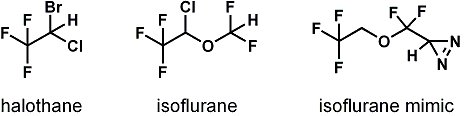
A synthetic organic chemist may scoff at the structural simplicity of anesthetics like halothane and isoflurane (see figure), but there's no doubt that the effects they have on our physiology are very complex. These compounds bring on amnesia (unconsciousness/ unawareness), analgesia (pain relief), and paralysis, and all of these effects are completely reversible. When a new anesthetic emerges, it's important to figure out the molecular mechanisms behind its activity, but researchers are still very much in the dark in this area.

It doesn't help matters that these molecules are challenging to work with in the lab. They're volatile (evaporate easily), and they don't have a very strong binding affinity for their target(s). The latter is a good thing since you want your anesthetic to wear off!

There is some data available about binding sites and targets for older anesthetics called haloalkanes (halothane is in this category), but those molecules really aren't used in human patients anymore because of their toxicity profiles. The goal of this paper is to develop a tool to get the same kind of data on the stuff we're actually using, the haloethers (like isoflurane).

To solve the low binding affinity problem, Xi and colleagues designed an isoflurane mimic (see figure) that's photoactivatable. The molecule resembles isoflurane, but it contains some chemical bonds that will break down when you shine light of a certain energy on them. Once that happens, what's left is a reactive species that they anticipated would latch onto a target, allowing them to better examine the interaction.

The conclusion of the paper was that the photoactivatable isoflurane mimic is a valid tool for research in this area. It behaves similarly to isoflurane in the petri dish and in animal tests, and binds to a known isoflurane target in a very similar place.

I did notice a couple of minor nomenclature errors in the paper: Isoflurane is 1-chloro-2,2,2-trifluoroethyl difluoroMETHYL ether, and the analogous correction also goes for desflurane.

The reactive group that the researchers engineered is called a carbene. An explanation of what that is is beyond the scope of this blog, but not of this website. Maybe someone who remembers carbene reactivity better than I do can answer the question they pose in the text: Is there an amino acid residue with which the UV-generated carbene won't react? They propose mutagenesis experiments, and I'm sure you can just buy a kit somewhere that'll take care of that, but there must be some references are already out there on this. The whole train of thought began when they didn't see the expected reactivity with tyrosine. It seems like they're trying to determine whether it's a question of intrinsic reactivity or just the molecule's "fit" in the cavity.

To do: the authors mentioned that the more old-school haloalkane anesthetics like halothane were used to fish out potential targets for interaction through photolabeling in complex mixtures. I'd like to see that experiment done with this analog. This kind of experiment has already been done in many other systems (for example, see here). I guess it just depends on how easily they can incorporate a visualization element.

Labels:

Thursday, August 10, 2006

I work for peanuts

I visited NYC after work last Saturday and supped at Spice, a Thai restaurant chainlet with a couple of locations in the city (I was on the Upper East Side). The decor was mod and minimalist and the food was great, but we limited our selection because one of my friends is highly allergic to peanuts.
Nature News ran an article a few weeks back that sheds a little more light on the mechanism behind anaphylactic shock. This is the most severe form of allergy, leading to a drop in blood pressure that is fatal if left untreated. We can treat someone who is in shock with a shot of epinephrine ("epi"), but this is more of a patchup; it doesn't get at the root of the problem and it can't prevent shock.
Here's the paper:
J. Clin. Invest. 2006, 116, 2244-2251.
In a nutshell (ha ha), the researchers confirmed previous reports that nitric oxide pathways are responsible, but the source of the nitric oxide wasn't the one they were expecting. They also pinpoint an often-studied signaling pathway (the PI 3-kinase pathway) as one of the orchestrators behind the whole nitric oxide-mediated shock response.
The PI 3-kinase pathway is involved in a large number of fundamental processes in our cells. A kinase is an enzyme that puts a tag (a phosphate group) on some other protein. The body uses phosphate groups as switches, adapters or handles for a ridiculous number of things. It's one of the ways the body physically transfers and amplifies a message. The authors conclude that it might be useful to look at the PI 3-kinase pathway as a way to intercept the shock response.
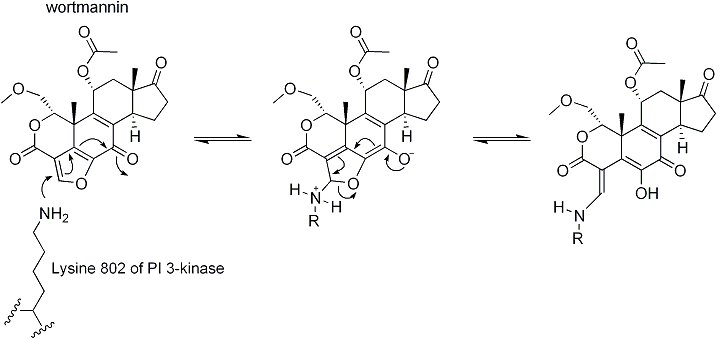
To demonstrate the involvement of PI 3-kinase, the researchers used wortmannin, my personal favorite inhibitor of PI 3-kinase. Wortmannin is a natural product made by fungi and it reacts with the business end of PI 3-kinase. For the mechanistically minded, I've included a figure.

The PI 3-kinase enzyme has a critical lysine involved in the phosphate transfer reaction, and wortmannin knocks that bad boy out of commission.

Labels:

Wednesday, August 09, 2006

Promiscuous G, you're teasing me.


I read this paper for a literature meeting nearly a month ago and I had meant to blog about it at the time. Here's the reference:
"Obestatin, a Peptide Encoded by the Ghrelin Gene, Opposes Ghrelin's Effects on Food Intake"
Science 2005, 310, 996-999.
Obestatin is a hormone that suppresses food intake and weight gain in mice (thanks to Harriet for the picture of the cute little mousie), so you can imagine that a lot of news outlets picked up the story when the paper came out last year. The message there was that finding obestatin provides a new drug target that could allow researchers and physicians to rein in that 10 AM candy bar craving in the not-too-distant future.

The work was fascinating to many researchers, not as the next big obesity cure, but because ghrelin and obestation come from the same gene and appear to have opposite effects! (Ghrelin increases body weight in mice.) The paper's authors first had a hunch that obestatin would exist because they performed a computer search of extensive genome sequence data for genes that look like they code for hormones. This touches off a debate on how much of an effect genomics has really had on the way we conduct research. See this post at In the Pipeline for commentary.

When I read this paper, I was drawn to the discovery that obestatin activates something called an "orphan G-protein-coupled receptor". Receptors are proteins that relay signals in the body in order to achieve some downstream effect, like muscle contraction. The human genome sequence has turned up a couple hundred genes that encode "G-protein-coupled receptors", a specific family of receptors with a track record of being valuable drug targets. Researchers don't yet know what interacts with "orphan receptors", but they'd eventually like to correlate them to a particular pathway or disease, so that they can eventually develop new and better drugs. That's why obestatin was such a big deal in the health field.

I guess this paper got me to thinking, "Isn't there a more proactive way to find the ligands (partners) for these orphan receptors instead of just waiting around for someone to publish papers like this one a couple of times a year?"

There are several ways that researchers go about this systematically. Scientists can take a little of the guesswork out of what the ligand is based on how similar the orphan receptor is to the ones we already know. Screening lots of potential partners at once is possible by coupling the receptor-ligand interaction to some kind of readout. The "adapter" they use is a G protein. Yes, these receptors are coupled to a G protein that sends out a message on its behalf. That's where the name "G-protein-coupled receptor" comes from.

So, why a promiscuous G protein? Promiscuous G's can speak for a wide range of receptors. It's much easier to set up the experiment if you don't have to change multiple components. Just get the new receptor that you want to test and all the other pieces are ready to go.

Unfortunately, there's no "universal adapter" quite yet. These screens are used often in drug discovery, but for now, scientists are getting by with an assortment of naturally occurring promiscuous G proteins and a few that they've engineered in the lab, and having to pick the one that works best for their system.

See these refs:
TRENDS Pharmacol. Sci. 2005, 26, 595-602.
Annu. Rev. Pharmacol. Toxicol. 2004, 44, 43-66.
Receptors and Channels 2002, 8, 297-308.
TRENDS Pharmacol. Sci. 2001, 22, 560-564.

Labels:

Monday, July 24, 2006

Curb your enthusiasm?


A lot of labs in my field are doubtless interested in a newly-reported compound, platensimycin, which showed potent antibacterial activity in the lab against pathogens that are resistant to multiple antibiotics. The structure is certainly intricate, what with five interlocking rings. Here's the reference:

Wang, J. et al. Nature 2006, 441, 358–361.

Researchers at Merck verified that platensimycin, which was isolated from a simple soil microbe in South Africa, inhibits a key enzyme that bacteria use to make fatty acids. This is cool because it's different from a lot of the antibiotics used in the clinic. Researchers realize that it's important to find new classes of antibiotics in order to stem the tide of resistance that's emerged due to widespread, indiscriminate drug use.

It's also significant that platensimycin is a natural product, that is, a compound crafted by an organism found in nature. Over the last ten or fifteen years, pharma companies had moved away from finding inspiration for new drugs in nature, preferring instead large collections of molecules stored in databases because they were more compatible with emerging high-tech discovery methods. (See this article in C&E News.)

I just thought I'd comment on the spate of articles that tout platensimycin as a potential cure for "the superbugs", as the multiply resistant bacteria have come to be called. (ei: See here and here.) My understanding has always been that if a pharmaceutical company publishes their results this early into the discovery process, it is because there are difficulties that are most likely going to prevent it from being a viable candidate. So while they almost certainly patent the compound, the paper puts the knowledge out there and the total syntheses and other studies can commence outside the company.

I think that the message of the Nature paper isn't really, "Hey everybody, here's platensimycin! It'll be the next magic bullet as soon as we test it in humans!" but rather, "Look, there are still useful ideas to be found by going back to nature and hunting in exotic places, instead of just sticking to libraries of compounds. Let's really dedicate some thought to targeting this fatty acid-making pathway. Nature's probably making compounds like platensimycin for a reason, and plus, it may take bacteria longer to adapt to a new kind of antibiotic." Hmmm.. maybe it doesn't sound as newsworthy that way. I do think that Nature got it right in this article, though.

Labels:

Tuesday, July 18, 2006

Double Your Pleasure, Double Your Fun

Every week, I look up papers about stuff that comes up in group meeting that I’m rusty at or haven’t heard of, and today I stumbled upon these gems while reading about phenol oxidations using hypervalent iodine.

Read:
Tet. Lett. 1988, 29, 677-680.
J. Chem. Soc. Perkin Trans. 1993, 1891-6.

They’re published five years apart, and the data tables are exactly the same, except for one new reaction. The person that ran that reaction wasn’t even granted authorship. The Perkin paper expands on the narrative a little, refers you to a few syntheses where the methodology was employed, and has a new scheme with a proposed mechanism, but no data to back up the proposal. At least it cites the Tet. Lett…

Labels:

Ice-Nine for Proteins

The BBC reports that researchers at Imperial College and the University of Surrey have found a material that can initiate formation of high quality protein crystals. The article emphasizes the finding's potential applicability in drug discovery but cautions that it isn't "one size fits all proteins".

I've really just scratched the surface in terms of my reading list, but it's not often I come upon an orphan news story. Perhaps this is a bit esoteric for the rest of the mainstream media outlets, but I was also curious why the report did not come out in January, which is when the article was published in PNAS. There's nothing the BBC says to suggest there's been any new advance since then.
Chayen, N.E.; Saridakis, E.; Sear, R. P. PNAS 2006, 103, 597-601.

*****Protein X-Ray Crystallography in a Nutshell*****
A protein crystal is a repeated array of a protein molecule, packed together in a regular pattern. Scientists in the field of x-ray crystallography bombard protein crystals with radiation and then determine the protein's 3D atomic structure.
This isn't trivial; proteins contain thousands of atoms. Nowadays, computers do much of the heavy lifting in terms of the math involved, but crystallographers guide the process the whole way through.

(See Dylan's blog for a snippet of a "classic" crystallography paper. It was a lot harder back in the day. That was just ONE AMINO ACID!)X-ray crystal structures of proteins can tell scientists how an enzyme works or how proteins interact with one another. Since these structures reveal the nooks and crannies of these proteins, they allow researchers to sculpt drug candidates that fit the mold.
*****

The BBC tidbit was near and dear to my heart, because when I was an undergraduate, I worked on part of my thesis research in a protein crystallography lab at a nearby pharma company. Though I'll be the first to admit that crystallizing an already-solved enzyme with a point mutant near the active site (a place less likely to perturb crystal packing) isn't the most challenging of projects, at the time I was really proud of having accomplished a little body of work that WORKED and provided some useful information.

My understanding is that crystallization remains the rate-determining step of solving structures. Rock candy this ain't. Any advance that provides a better microscopic picture of nucleation, the starting point for crystal formation, is going to be very helpful in the quest to crystallize "stubborn" proteins. It's known that introducing an external solid into the crystallization "broth" can produce better-ordered crystals. The material Chayen et al. found works because it has a wide distribution of pore sizes and shapes, making it more likely that a given pore will convince protein molecules to stick around and nucleate. If I had more time on my hands, I would check up on the proteins they crystallized using their method and see how diverse they are, or if any were known to be particularly challenging by traditional methods.

PS: The title refers to a material made up for Vonnegut's "Cat's Cradle". Ice-nine was supposed to be a high-melting allotope of water that would act as a "seed crystal" and instantly solidify your afternoon tea, and even (for those with visions of world domination) entire bodies of water.

Labels: